A Collector's Lexicon: The Hidden Language Stamped Into Every Gulf Heirloom
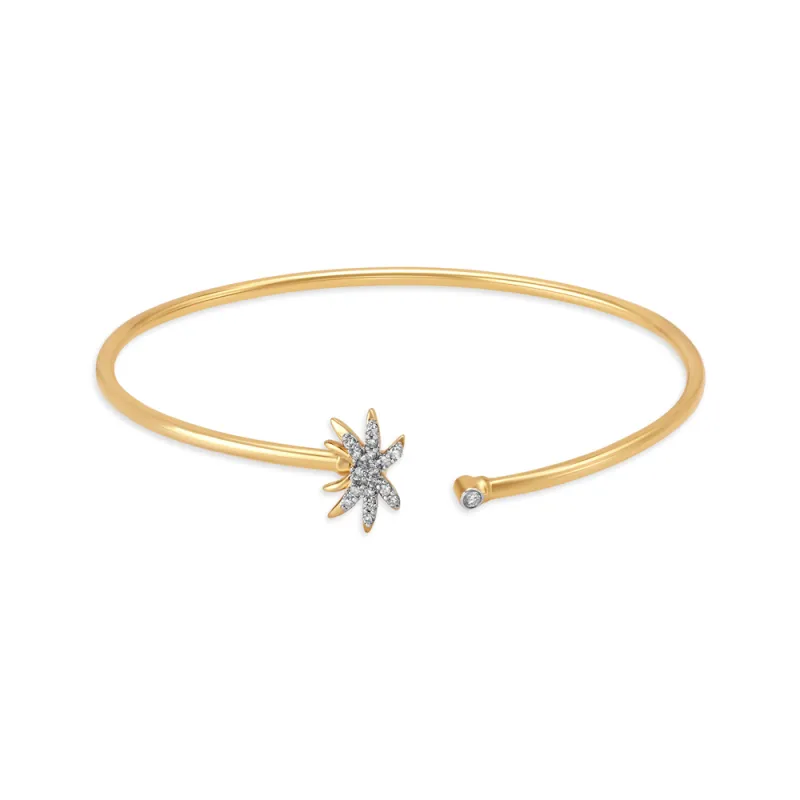
Photo: ornate gold bangle with palm tree engraving Middle Eastern jewelry close up, via www.tanishq.co.in
There is a moment familiar to every serious collector. You are standing before a vitrine in Dubai, gold catching the low desert light, and you recognize that the piece in front of you is not merely beautiful—it is communicating. The question is whether you can hear it.
American buyers have grown fluent in European design codes. We know what a fleur-de-lis signals, why a serpent coiled around a wrist meant eternity to the Victorians, and what a Cartier panther implies about its wearer. But the motifs of the Gulf—the date palm, the falcon, the pearl diver, the sabkha—carry an equally rich vocabulary that most stateside shoppers have never been taught. This is that lesson.
The Date Palm: Generosity Made Permanent
Begin with the motif you will encounter most often. The date palm appears on Emirati currency, national emblems, and—most intimately—on the clasps and bangles of fine jewelry throughout the region. Its meaning is not decorative. For Bedouin communities, the palm was survival itself: shade in fifty-degree heat, food in the leanest months, fiber for rope and shelter for the living.
When a Gulf goldsmith sets a palm frond into a cuff, they are stamping the piece with a wish: may your household never want. In the American context, think of it as the region's answer to the wheat sheaf or the oak branch—except earned through genuine hardship rather than borrowed from heraldry. A palm-motif bangle from JADA's ateliers is, functionally, a blessing you can wear to a Houston dinner party.
The Falcon: Sovereignty in Miniature
Falcons occupy a place in Emirati culture that Americans might compare to thoroughbred horses in Kentucky—except the relationship is older, deeper, and written into law. Falconry arrived with the Bedouin, who used the birds to hunt game across terrain that could not support a hunting dog. The falcon became a symbol of nobility, patience, and self-command: it is never caged casually, never flown by the unworthy.
In jewelry, the falcon in flight or with folded wings signals independence and inherited dignity. Collectors should note the distinction: a falcon with wings spread suggests ambition and new ventures, while the perched bird speaks to stewardship and watchful authority. Either way, a falcon piece is rarely chosen by accident. It tends to find women who have built something and intend to keep it.
The Pearl Diver: The Region's Original Fortune
Long before oil, the Gulf ran on pearls. For centuries, men from coastal towns—many of them in what is now the UAE—rowed out for months-long diving seasons, holding their breath to depths of ten meters and more, hauling oysters from the seabed in a trade that claimed lives and built fortunes alike.
Motifs honoring the diver appear as silhouettes mid-descent, as dhows (the wooden sailing vessels) under full sail, or as abstracted water patterns rendered in engraving and granulation. When you see a dhow on a pendant, understand that you are looking at the Gulf's version of the tall ship on a Nantucket signet ring—except the stakes were higher and the memory is more recent. Many Emirati families can name grandfathers and great-uncles who dived. A diver motif honors that inheritance.
The Sabkha: Beauty Where Nothing Grows
Perhaps the most sophisticated motif, and the one most often missed by foreign eyes. The sabkha is the salt flat—those crystalline crusts where the desert meets the sea, blindingly white, geometrically cracked, seemingly lifeless. To an outsider, it is empty ground. To Emirati designers, it is texture, resilience, and the quiet drama of the landscape itself.
Jewelers translate the sabkha into tessellated gold surfaces, matte-and-polish contrasts, and engraved crackle patterns that shift with the light like the flats at dawn. Choosing a sabkha piece signals a collector who appreciates restraint—a woman who understands that the desert's most beautiful surface is also its most severe.
A Pocket Glossary for Your Next Commission
Keep these four translations close when browsing or commissioning:
- Nakhl (date palm): Abundance, hospitality, protection of the household.
- Saqr (falcon): Nobility, discipline, self-determination. The national bird and a national identity.
- Ghawwas (pearl diver): Sacrifice, courage, wealth earned by hand. Often paired with the dhow.
- Sabkha (salt flat): Endurance, purity, the austere beauty of the land.
Why the Story Changes the Piece
There is a practical reason this literacy matters. A motif you cannot read is a pattern; a motif you can read is a promise. When an American collector commissions a JADA piece, our goldsmiths are not decorating—they are composing, choosing symbols the way a poet chooses words. The client who arrives knowing the vocabulary receives a different piece entirely: one calibrated to her story, not just her measurements.
And there is a legacy argument as well. The finest heirlooms in any family carry meaning that outlives the memory of the purchase. A granddaughter who inherits a palm-and-falcon bracelet will ask what it means. The answer—abundance guarded by sovereignty—is a better inheritance than carat weight alone.
Learn the language. The gold has been speaking all along.